Retailers are moving into insurance distribution at a pace few predicted a decade ago. Most of those embedded distribution partnerships will never grow past a marketing campaign.
This blog, part of a series on embedded insurance verticals, explains why.
The answer has less to do with the retail brand than most assume, and almost everything to do with whether the cover was designed around a moment the retailer already owns.
Retail's embedded insurance land grab
Tesco now sells life insurance underwritten and administered by Aviva. So does Asda, in partnership with Allianz UK; an offering that was recently expanded to include home and motor insurance. Morrisons has recently launched pet and travel cover, rewarding More Card holders with loyalty points and a 10% discount on travel.
All of these retailers are insurance distributors, who have partnered with capacity providers to add insurance to their offerings.
Retailers already have an intrinsic customer relationship and brand loyalty that insurers spend years trying to build. Loyalty schemes and store credit accounts also capture exactly the signals underwriters want: purchasing behaviour, household composition, life-stage change, alongside basic customer data.
For insurers and MGAs, the opportunity is obvious and well-documented.
The harder question is why so many of these partnerships stay stuck at a marketing campaign, while only a handful change how customers buy protection.
Designing for embedded insurance in retail
Retail is different to other verticals because nothing compels the purchase. Retail distributors must first convince the customer that they need cover and then demonstrate its value during the journey, before price even enters the conversation.
That single fact changes what good design means.
Friction is the first problem to solve because every extra step in the customer journey is a chance for someone who was never obliged to buy anything to walk away (read more about how to reduce friction in customer journeys).
Solving for that friction is also why embedded retail products all share the same shape:
- Minimal or no underwriting questions
- Short sign-up journeys
- Cover is bound during the underlying transaction or customer journey
Products that were designed for an insurer's own direct channels, and that retain that design wherever they are embedded, struggle in retail channels because a full quote-and-apply process and individual underwriting cannot be collapsed into a checkout.
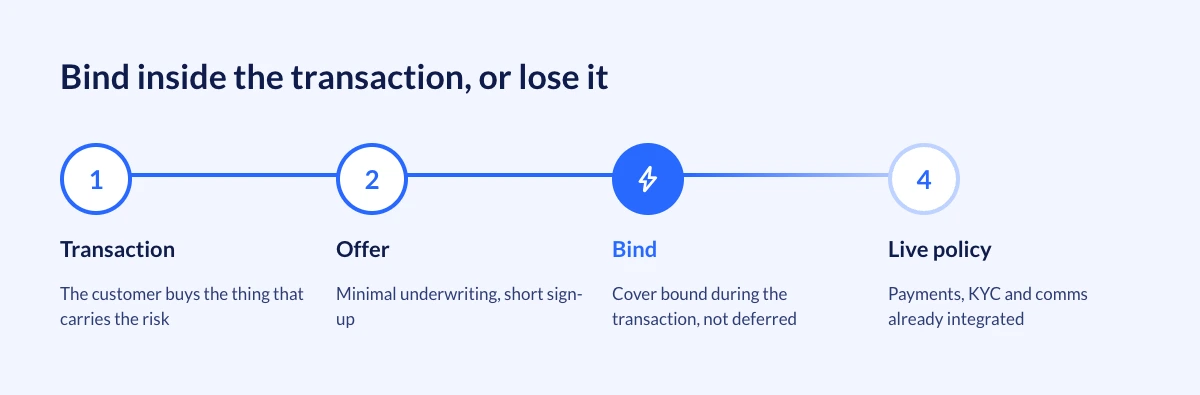
The discipline is deciding, before launch, which questions you are willing to lose customers over. We’ve seen this tension time and time again: the insurer wants more information for more accurate underwriting, but the distribution partner wants a simple, elegant customer experience that converts. That decision usually has no clear owner, which is why it gets reopened many times before launch.
All of which narrows the problem to one thing.
If nothing compels the purchase, and every extra step costs customers, then timing is the only real asset a retail partnership has.
In retail, the moment is all you have
The real asset when partnering with a retailer for distribution is owning the moment.
Sell to a customer at a moment where the risk is understood and top of mind, and the sale is easier. Reach out to them a week later by email with a targeted offer and the customer will probably no longer want cover.
From a technology perspective, the infrastructure supporting embedded models of insurance distribution must therefore do more than simply move data between systems.
It has to enable underwriting and binding to be fast enough to capture and retain the customer's attention at the critical point in the journey.
In practice, the product tends to be the easier part of the build, particularly where pricing is fixed or flexes on only a few rating factors. The harder work is in the issuing flow: premium collection, automated KYC and policyholder communications. Each has to run inside the partner’s journey rather than beside it, and each is usually orchestrated across systems belonging to different parties.
So, which embedded insurance moments do you actually own?
Most retail insurance conversations start by asking about which insurer or distributor to partner with, or which product to offer.
Start instead with an inventory of moments.
Retailers habitually think about insuring the products that are sold on their shelves, because that is where the obvious risk sits. Yet every retailer intermediates far more than it manufactures.
Most retailers now offer a delivery service. Furniture, homeware and building materials retail chains offer installation or assembly services too. Electronic goods retailers provide repair services.
Bookings, subscriptions and value-added services are now a feature of modern retail and e-commerce, and are all moments to offer embedded covers.
Four retailer case studies, four different answers
Currys and Tesco Mobile: the payment relationship is a moment
Currys is the UK and Ireland's largest specialist electrical goods retailer, selling white goods, computers, televisions and mobile phones through stores and online.
Its mobile insurance, underwritten by Chubb, is offered in a Lite and a Complete version when adding a device and mobile subscription bundle to your basket on its Carphone Warehouse brand’s online store. Premiums are paid monthly or annually, and replacement devices are refurbished models supplied with a Currys warranty.
The offer to add insurance is not made when purchasing a SIM free handset. Buying a handset bundled with a mobile subscription establishes a recurring payment, whereas a SIM-free purchase of the device only is a once-off transaction.
Similarly, Tesco’s Mobile Protect is sold when a customer buys a new phone or upgrades on Tesco’s own mobile network, and Tesco is explicit that it cannot be bought once the contract has started. Both the premium and the excess are calculated from the value of the device at the point of purchase.
What connects both examples is the payment relationship.
Device insurance charges a recurring premium, so it needs a payment relationship that persists after the customer completes the initial transaction. A monthly or annual pay contract creates one. A SIM free card payment does not, and the customer leaves the transaction with no persisting rail to collect against.
A recurring premium needs a recurring payment relationship the partner already owns. Where the partner holds only a one-off transaction, the cover has to be a single premium, paid once, at the point of sale.
El Corte Inglés: insuring what you intermediate
El Corte Inglés, Spain's largest department store group, runs Venta de Entradas El Corte Inglés, a ticketing platform selling concerts, theatre and live shows.
Customers buy online at elcorteingles.es/entradas, or in person at staffed ticket desks inside the department stores themselves, and they can collect tickets bought online at those same counters.
Alongside those tickets, El Corte Inglés sells GaranTicket. It is cancellation cover, available only at the point of purchasing the tickets and only up to 48 hours before the event begins.
There is no way to buy GaranTicket outside of checkout. This works because GaranTicket is paid once, at the point of sale, for a period that ends when the event starts. There is no recurring relationship to maintain, because none is needed.
This transaction does not involve any retail goods: El Corte Inglés intermediates a service, and the insurance is bundled with that intermediation rather than with a product from its shelves.
El Corte Inglés now runs around 20 insurance products across 8 lines, and it got there by taking an inventory of the moments it already owned rather than an inventory of the products it sells.
Decathlon and Halfords: free cover as a conversion mechanism
Decathlon UK gives 15 days of free cover with every bike purchased, provided in partnership with the cycle insurer Laka.
Halfords does almost exactly the same thing. Its cycle customers receive 14 days of free cover through Ripe's Cycleplan product, protecting the bike against theft and accidental damage, with an annual policy offered at the end of the free period.
The demand problem is stark. When Decathlon first moved into bicycle cover, it cited figures showing that just 18% of UK cyclists are insured, despite 28 million people owning a bike.
Nobody is required to insure a bicycle, and apparently most people don’t. Where the customer already perceives the risk, cover sells at full price from the day the item is purchased.
Free trial cover addresses this directly. The moment of purchase establishes the relationship and demonstrates the product; paid conversion happens afterwards, while the retailer and insurer have the opportunity to persuade the customer that a risk exists at all.
Sainsbury’s: when the moment isn’t there
Sainsbury's available range of products covers pet (provided by Pinnacle Insurance), life (by L&G) and travel insurance (by AWP P&C).
Through its Nectar loyalty programme, members receive up to 20% off travel insurance and a guaranteed discount on pet insurance, which Sainsbury's calculates based on information related to the customer and the transactions they have made in Sainsbury's supermarkets. Holding a policy then earns double Nectar points on grocery and fuel spend, up to 20,000 bonus points a month.
What Sainsbury’s has not done is build cover into a checkout the way Carphone Warehouse or Tesco Mobile have, and its position explains why. Groceries and general merchandise do not create insurable moments in the way handset, ticket or bike purchases do.
But where the group does own that kind of moment, at the point of buying electricals from its Argos brand, it runs a point-of-sale offering through Argos Care.
Data alone does not create a moment, and the transaction itself has to carry a risk the customer recognises.
Why embedded partnerships stall in retail
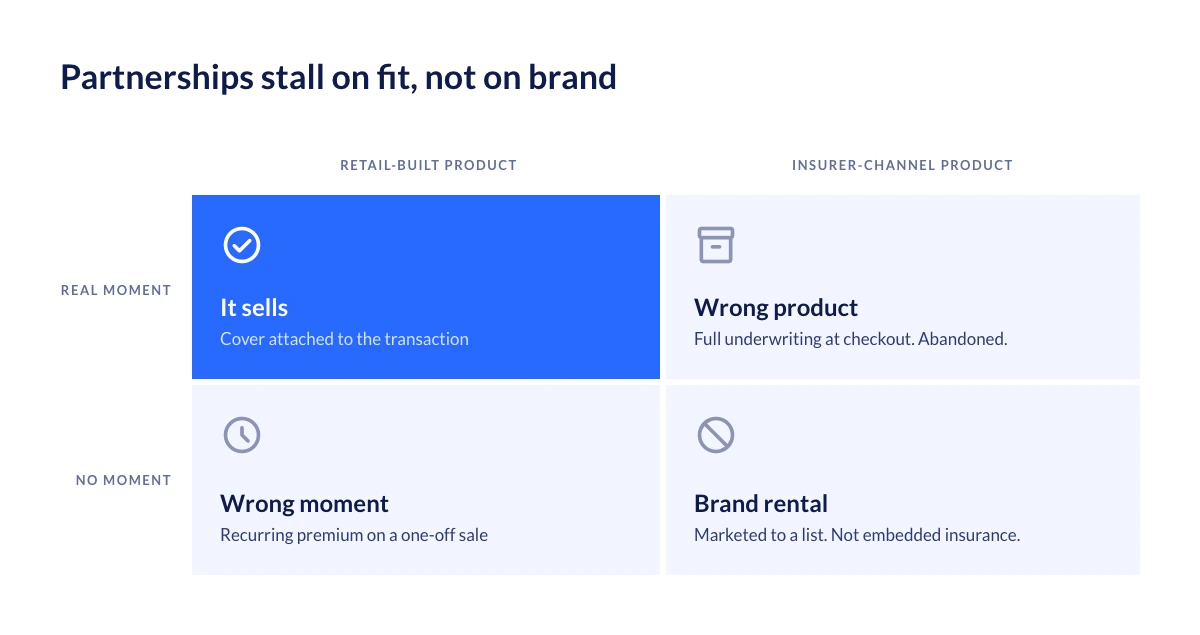
Retail insurance partnerships stall in 3 identifiable ways, and none of them has much to do with the strength of the retail brand.
The wrong product for the moment
Cover designed for an insurer's own channel arrives carrying full underwriting and a quote-and-apply journey. When positioned at checkout, the product is abandoned or relegated to a marketing campaign.
The wrong moment for the product
The product works and the retailer owns a genuine moment, but the two do not fit. A recurring premium attached to a one-off transaction is the clearest illustration of this, and it’s the reason the same cover appears in one Currys journey and not the other.
No moment at all
This is the one that is most obvious to spot in pre-launch conversations. A partner has a large customer base and a solid well-designed product but no transaction to attach it to. Invariably, the programme gets designed as a campaign, with the retailer renting out its brand and database. This may be a reasonable business, but it is not embedded insurance and it will not perform like it.
The retailers getting this right are not the ones with the largest customer base or best product. They are the ones who started with an inventory of the moments they already owned, rather than an inventory of products they could sell.
Where to start
The hardest question is figuring out which moments you can actually build for, and how quickly you can do it again with the next partner.
That is the part we work on. Root gives insurers, MGAs and their distribution partners the infrastructure to design and administer cover around a specific moment, bind it inside a partner's journey, and stand the next product up with the next partner.
If you have a moment in mind, we’d love to hear about it. Reach out to find out how we can help you build your embedded distribution partnership.